AI. WITHOUT METHOD. WITHOUT EFFECT
Welcome to the Companion Universe.
We're pleased you're here.
Your methodical AI companion for when gut instinct becomes too expensive.

Transfer support with methodology
The seminar teaches the method. The AI Companion makes it applicable to the participant’s own case. After the seminar, it accompanies the participant into real-world situations. Transformations that get stuck. Negotiations that require methodological support. And in each of these moments, the same foundation: structured guidance exactly where the seminar ends.
Sustainability and anchoring
The participant brings more than methodology, they bring a new way of working. Create an AI landscape, a library that grows. A standard that becomes established. Cross-functional, situational, scalable. And in every application, the same foundation: proven methods embedded in your processes for real confidence in everyday action.
The Companion in the role of an AI-powered co-trainer and instructor.
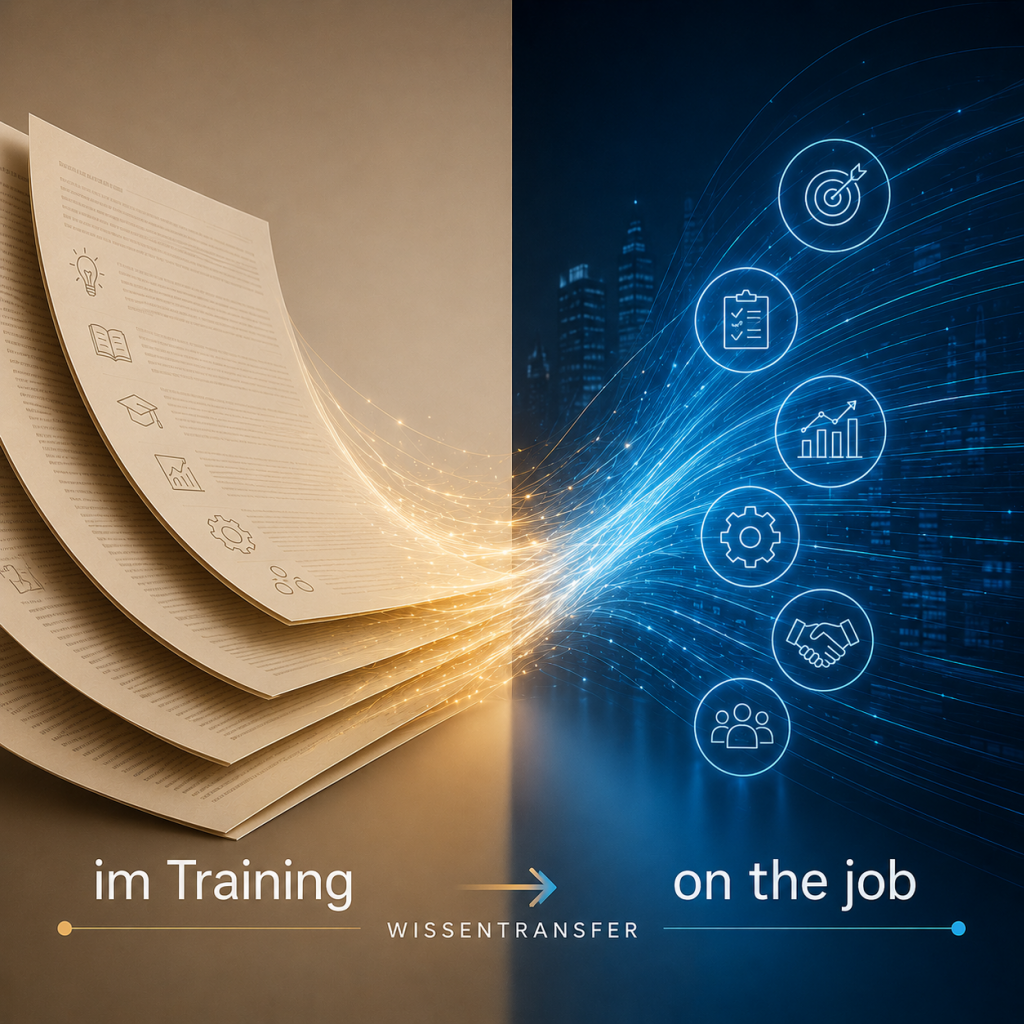
Knowledge transfer into practice is the success factor of every training program. However, the gap between the seminar room and practical competence remains a real phenomenon
AI creates new opportunities. The AI Companion promises measurable impact. In AI education, participants develop methodically grounded AI Companions tailored to their organization.
Knowledge transfer into practice is the success factor of every training program. However, the gap between the seminar room and practical competence remains a real phenomenon
AI creates new opportunities. The AI Companion promises measurable impact. In AI education, participants develop methodically grounded AI Companions tailored to their organization.
Knowledge transfer into practice is the success factor of every training program. However, the gap between the seminar room and practical competence remains a real phenomenon
AI creates new opportunities. The AI Companion promises measurable impact. In AI education, participants develop methodically grounded AI Companions tailored to their organization.
Why does knowledge transfer often end exactly where it is needed most
Not because of a lack of motivation. But because transfer support ends where practice begins. Coaching and mentoring can close this gap individually and effectively. However, they are cost-intensive and not scalable
Wie verändert der Companion das Seminar?
The participant applies the method to a case study and reflects on the outcome with the instructor. The Companion supports the learning journey situationally, tailored to the participants’ context and made tangible through experience
Was zeichnet den Companion gegenüber Coaching aus?
It is developed with the expertise of experienced instructors. It understands the method, knows the context, and speaks the language of your content. Not a generic advisor. A methodologically grounded sparring partner.
Welche Rolle spielt der Companion in der Praxis?
It continues to reinforce knowledge retention by structuring critical situations in practice and reflecting on them with methodological support. Exactly when it matters, not as an advisor, but as a sparring partner.
Why does knowledge transfer often end exactly where it is needed most
Not because of a lack of motivation. But because transfer support ends where practice begins. Coaching and mentoring can close this gap individually and effectively. However, they are cost-intensive and not scalable
Wie verändert der Companion das Seminar?
The participant applies the method to a case study and reflects on the outcome with the instructor. The Companion supports the learning journey situationally, tailored to the participants’ context and made tangible through experience
Was zeichnet den Companion gegenüber Coaching aus?
It is developed with the expertise of experienced instructors. It understands the method, knows the context, and speaks the language of your content. Not a generic advisor. A methodologically grounded sparring partner.
Welche Rolle spielt der Companion in der Praxis?
It continues to reinforce knowledge retention by structuring critical situations in practice and reflecting on them with methodological support. Exactly when it matters, not as an advisor, but as a sparring partner.
The Companion in the role of an AI-powered guide for your critical processes.
The best partner in the decisive moment.
A negotiation where a great deal is at stake. A conversation that has long been avoided. A transformation that has stalled. This is precisely where the Companion supports you as a methodical partner — one who understands the context behind your situation, recognises what is at stake, and guides you through the moment that truly matters.

The right methodology in the given context.
Every situation brings its own complexity. Knowledge must be gathered, validated, and made available at the right moment. Conversations need to be prepared, conducted with intention, and reflected upon afterwards. The Companion combines proven methods with your specific context so that you can act with confidence, structure, and impact at every stage.
Der beste Partner im richtigen Moment
A negotiation where a great deal is at stake. A conversation that has long been avoided. A transformation that has stalled. This is precisely where the Companion supports you as a methodical partner — one who understands the context behind your situation, recognises what is at stake, and guides you through the moment that truly matters.
The right methodology in the given context.
Every situation brings its own complexity. Knowledge must be gathered, validated, and made available at the right moment. Conversations need to be prepared, conducted with intention, and reflected upon afterwards. The Companion combines proven methods with your specific context so that you can act with confidence, structure, and impact at every stage.
Strategic Sales.
From tender submission to signed contract.
Initial situation.
A B2B software company receives an RFP for a €480,000 deal — with eight weeks to respond and a buying centre of seven stakeholders. The last three comparable deals were lost, each time with the same feedback: “Your expertise was excellent, but…”
Companion deployment.
Strategic Decision Companion: Structure the go/no-go decision, assess the probability of success, and evaluate portfolio allocation.
Stakeholder Management Companion: Identify all decision-makers, create a power–interest grid, and activate a champion.
Harvard Negotiation Companion: Develop the BATNA, analyse the client’s interests, and identify critical negotiation moments.
Outcome and conclusion.
A “hidden blocker” was identified early and deliberately engaged. The price negotiation concluded with an 8% discount instead of the usual 15–20% — because the BATNA was clearly defined.
“For the first time, I felt that I was truly steering the deal rather than merely reacting.”
Leadership and conversations
From a critical employee conversation to a constructive turning point.
Initial situation.
A team leader must speak with her senior controller (eight years with the company): missed deadlines, errors in reports, and complaints from the team. HR is pushing for a documented conversation. The dilemma: too hard he resigns; too soft nothing changes.
Companion deployment.
DISC Companion – Analyse the behavioural profile: High C — requires structure, facts, and time to process. Avoid putting them under pressure.
Difficult Conversations Companion – Develop a nonviolent communication structure, prepare SBI examples, simulate emotional reactions, and clarify legal boundaries.
Delegation Companion – Define measures and follow-up meetings, and prepare legally compliant documentation.
Outcome and conclusion.
The real reason emerged: caring for his mother with dementia — something he had concealed out of shame. The nonviolent communication structure created the space for this to surface. After eight weeks: performance stabilised and trust had grown.
“Without the preparation, I would never have created the space for him to open up.”
Change Management
From a blocked implementation to an accepted change.
Initial situation.
A manufacturing company (450 employees) invests €1.2 million in an AI planning tool — after six weeks of the pilot phase: 23% adoption. Key users are blocking progress, and training sessions are being avoided. Three failed initiatives in the past five years have created deep mistrust.
Companion deployment.
Reifegradanalyse Companion: Spannungsfeld Dimensionen analysieren, Strukturelle und Kulturelle Reife bewerten.
Lewin Transformation Companion: Develop a force field analysis, define action areas and structural measures, and create visions, missions, quick wins, and prototypes.
Kotter Change Companion: Create a sense of urgency, build a leadership coalition, identify resistance, and implement the change process.
Outcome and conclusion.
he most sceptical shift supervisor became an “AI ambassador” — his first suggestion was implemented within 48 hours. Go-live reached 78% adoption (benchmark: 45%), with sustained usage of 84% after six months.
“AI projects are not IT projects — they are change projects.”
Strategic Sales.
From tender submission to signed contract.
Initial situation.
A B2B software company receives an RFP for a €480,000 deal — with eight weeks to respond and a buying centre of seven stakeholders. The last three comparable deals were lost, each time with the same feedback: “Your expertise was excellent, but…”
Companion deployment.
Strategic Decision Companion: Structure the go/no-go decision, assess the probability of success, and evaluate portfolio allocation.
Stakeholder Management Companion: Identify all decision-makers, create a power–interest grid, and activate a champion.
Harvard Negotiation Companion: Develop the BATNA, analyse the client’s interests, and identify critical negotiation moments.
Outcome and conclusion.
A “hidden blocker” was identified early and deliberately engaged. The price negotiation concluded with an 8% discount instead of the usual 15–20% — because the BATNA was clearly defined.
“For the first time, I felt that I was truly steering the deal rather than merely reacting.”
Führung und Gespräche
From a critical employee conversation to a constructive turning point.
Initial situation.
A team leader must speak with her senior controller (eight years with the company): missed deadlines, errors in reports, and complaints from the team. HR is pushing for a documented conversation. The dilemma: too hard he resigns; too soft nothing changes.
Companion deployment.
DISC Companion – Analyse the behavioural profile: High C — requires structure, facts, and time to process. Avoid putting them under pressure.
Difficult Conversations Companion – Develop a nonviolent communication structure, prepare SBI examples, simulate emotional reactions, and clarify legal boundaries.
Delegation Companion – Define measures and follow-up meetings, and prepare legally compliant documentation.
Outcome and conclusion.
The real reason emerged: caring for his mother with dementia — something he had concealed out of shame. The nonviolent communication structure created the space for this to surface. After eight weeks: performance stabilised and trust had grown.
“Without the preparation, I would never have created the space for him to open up.”
Change Management
From a blocked implementation to an accepted change.
Initial situation.
A manufacturing company (450 employees) invests €1.2 million in an AI planning tool — after six weeks of the pilot phase: 23% adoption. Key users are blocking progress, and training sessions are being avoided. Three failed initiatives in the past five years have created deep mistrust.
Companion deployment.
Reifegradanalyse Companion: Spannungsfeld Dimensionen analysieren, Strukturelle und Kulturelle Reife bewerten.
Lewin Transformation Companion: Develop a force field analysis, define action areas and structural measures, and create visions, missions, quick wins, and prototypes.
Kotter Change Companion: Create a sense of urgency, build a leadership coalition, identify resistance, and implement the change process.
Outcome and conclusion.
he most sceptical shift supervisor became an “AI ambassador” — his first suggestion was implemented within 48 hours. Go-live reached 78% adoption (benchmark: 45%), with sustained usage of 84% after six months.
“AI projects are not IT projects — they are change projects.”
Customer Service
From escalation to a strengthened partnership in 48 hours
Initial situation.
The most important customer (€850,000 ARR) threatens to terminate the contract after two weeks of system instability. The CTO sends an angry email — CC to the CEO — with a video call scheduled for tomorrow. The CSM is expected to lead the conversation, acting as a lightning rod for problems he did not cause.
Companion deployment.
DISC Model Companion: Analyse the CTO’s personality profile — high D indicator: direct, solution-oriented, no excuses.
Difficult Conversations Companion: Develop a Nonviolent Communication structure, simulate emotional reactions, and define the compensation framework.
Stakeholder Management Companion: Identify the CFO as the actual decision-maker, activate an internal advocate, and clarify the escalation path.
Outcome and conclusion.
The conversation remained constructive rather than escalating. Clear measures were agreed, the contract continues and the relationship was even strengthened.
“This is what I call a true partnership.”
Legal / Controlling
Von der Vertragsvorlage zur risikogeprüften Freigabe
Initial situation.
An IT services provider is negotiating a €320,000 deal. The draft contract arrives on Friday at 4 p.m., with the signature expected on Monday. The last similar contract resulted in a liability case of €180,000. Legal has become more cautious, while sales argues: “You slow down every deal.”
Companion deployment.
Contract Review Companion – Compare terms and conditions, identify critical clauses, and prioritise them: critical vs. negotiable vs. acceptable.
Strategic Decision Companion – Create a risk matrix, quantify financial implications, and classify red lines.
Stakeholder Management Companion – Orchestrate the approval process and resolve the Sales–Legal conflict on the basis of shared facts.
Outcome and conclusion.
The review was completed in four hours instead of two days. Three red lines were identified, and the deal was concluded with adjusted terms and clear risk protection.
“For the first time, Sales and Legal had the same factual basis.”
AI Prototyping
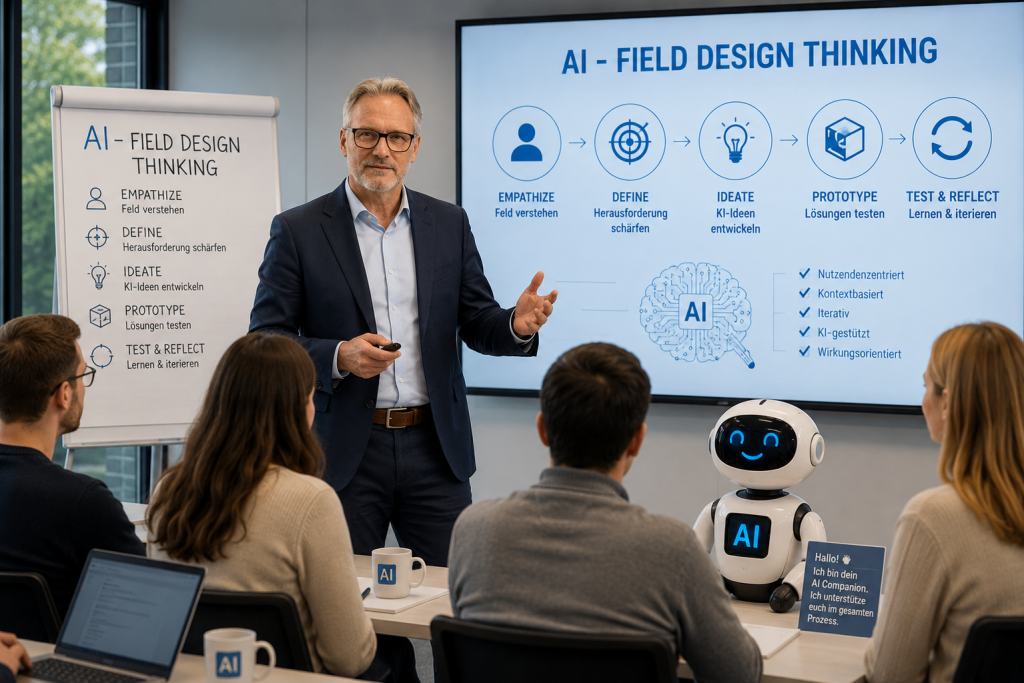
AI Field Design Thinking: Anticipating Areas of Tension, Anchoring Deployment
Initial situation.
A mid-sized software company is facing increasing competitive pressure. After years of double-digit growth, revenue has stagnated. Core processes in marketing, product development, and customer support operate without alignment. Escalation signals are overlooked, market intelligence remains unused, and editorial processes consume capacity without adding value. Three departments, three areas of tension and no shared flow of information
Companion deployment.
Content Engine Companion, analyzing editorial processes, establishing governance anchors: Who is responsible for brand voice in AI-generated content? Human-in-the-Loop as a response to areas of tension. The prototype tests systemic maturity, not just technology
Market Intelligence Companion, Ideen-Portal mit Priorisierungslogik verknüpfen: Entscheidungshoheit als Kernspannungsfeld klären, Übergabeparameter für den Piloten in Prozess- und Governance-Dimension verankern.
Customer Support Companion Beschwerdemanagement neu aufsetzen: Compliance, Eskalationsverantwortung und Teamakzeptanz gleichzeitig adressieren, Guardrails und Handlungsfelder Deployment-fähig definieren.
Outcome and conclusion.
Three areas, one platform, one closed information loop. The prototype has made areas of tension visible across all six dimensions and pre-structured fields of action for pilot and deployment. The transition into operation is not a rollout, but the result of accumulated knowledge from every iteration.
“AI Transformation Builds on the Digitalized System Environment”
Customer Service
From escalation to a strengthened partnership in 48 hours
Initial situation.
The most important customer (€850,000 ARR) threatens to terminate the contract after two weeks of system instability. The CTO sends an angry email — CC to the CEO — with a video call scheduled for tomorrow. The CSM is expected to lead the conversation, acting as a lightning rod for problems he did not cause.
Companion deployment.
DISC Model Companion: Analyse the CTO’s personality profile — high D indicator: direct, solution-oriented, no excuses.
Difficult Conversations Companion: Develop a Nonviolent Communication structure, simulate emotional reactions, and define the compensation framework.
Stakeholder Management Companion: Identify the CFO as the actual decision-maker, activate an internal advocate, and clarify the escalation path.
Outcome and conclusion.
The conversation remained constructive rather than escalating. Clear measures were agreed, the contract continues and the relationship was even strengthened.
“This is what I call a true partnership.”
Legal / Controlling
From contract template to risk-assessed approval.
Initial situation.
An IT services provider is negotiating a €320,000 deal. The draft contract arrives on Friday at 4 p.m., with the signature expected on Monday. The last similar contract resulted in a liability case of €180,000. Legal has become more cautious, while sales argues: “You slow down every deal.”
Companion deployment.
Contract Review Companion – Compare terms and conditions, identify critical clauses, and prioritise them: critical vs. negotiable vs. acceptable.
Strategic Decision Companion – Create a risk matrix, quantify financial implications, and classify red lines.
Stakeholder Management Companion – Orchestrate the approval process and resolve the Sales–Legal conflict on the basis of shared facts.
Outcome and conclusion.
The review was completed in four hours instead of two days. Three red lines were identified, and the deal was concluded with adjusted terms and clear risk protection.
“For the first time, Sales and Legal had the same factual basis.”
AI Prototyping
AI Field Design Thinking: Anticipating Areas of Tension, Anchoring Deployment
Initial situation.
Ein mittelständischer Softwarehersteller steht unter zunehmendem Wettbewerbsdruck. Nach Jahren zweistelligen Wachstums stagniert der Umsatz. Kernprozesse in Marketing, Produktentwicklung und Customer Support laufen unabgestimmt. Eskalationssignale werden übersehen, Marktintelligenz nicht genutzt, Redaktionsprozesse binden Kapazität ohne Mehrwert. Drei Bereiche, drei Spannungsfelder und kein gemeinsamer Informationsfluss.
Companion deployment.
Content Engine Companion, Redaktionsprozesse analysieren, Governance-Anker setzen: Wer verantwortet Markenstimme bei KI-Generierung? Human-in-the-Loop als Spannungsfeld-Antwort Prototyp testet systemische Reife, nicht nur Technik.
Market Intelligence Companion, Ideen-Portal mit Priorisierungslogik verknüpfen: Entscheidungshoheit als Kernspannungsfeld klären, Übergabeparameter für den Piloten in Prozess- und Governance-Dimension verankern.
Customer Support Companion Beschwerdemanagement neu aufsetzen: Compliance, Eskalationsverantwortung und Teamakzeptanz gleichzeitig adressieren, Guardrails und Handlungsfelder Deployment-fähig definieren.
Outcome and conclusion.
Drei Bereiche, eine Plattform, ein geschlossener Informationskreislauf. Der Prototyp hat Spannungsfelder in allen sechs Dimensionen sichtbar gemacht und Handlungsfelder für Pilot und Deployment vorstrukturiert. Der Übergang in den Betrieb ist kein Rollout sondern das Ergebnis sedimentierten Wissens aus jeder Iteration.
“AI Transformation Builds on the Digitalized System Environment”

 English
  German